
Clinnova at the Festival of Biologics 2026: Federating Digital Medicine in Europe
The Festival of Biologics took place at Messe Basel from 13 to 15 October 2026, bringing together more than 3,000 participants, 350 speakers and 150 exhibitors from across the biopharmaceutical sector. Clinnova took part to present its work on federated digital medicine and demonstrate how cross-border collaboration and data sharing can advance clinical research.
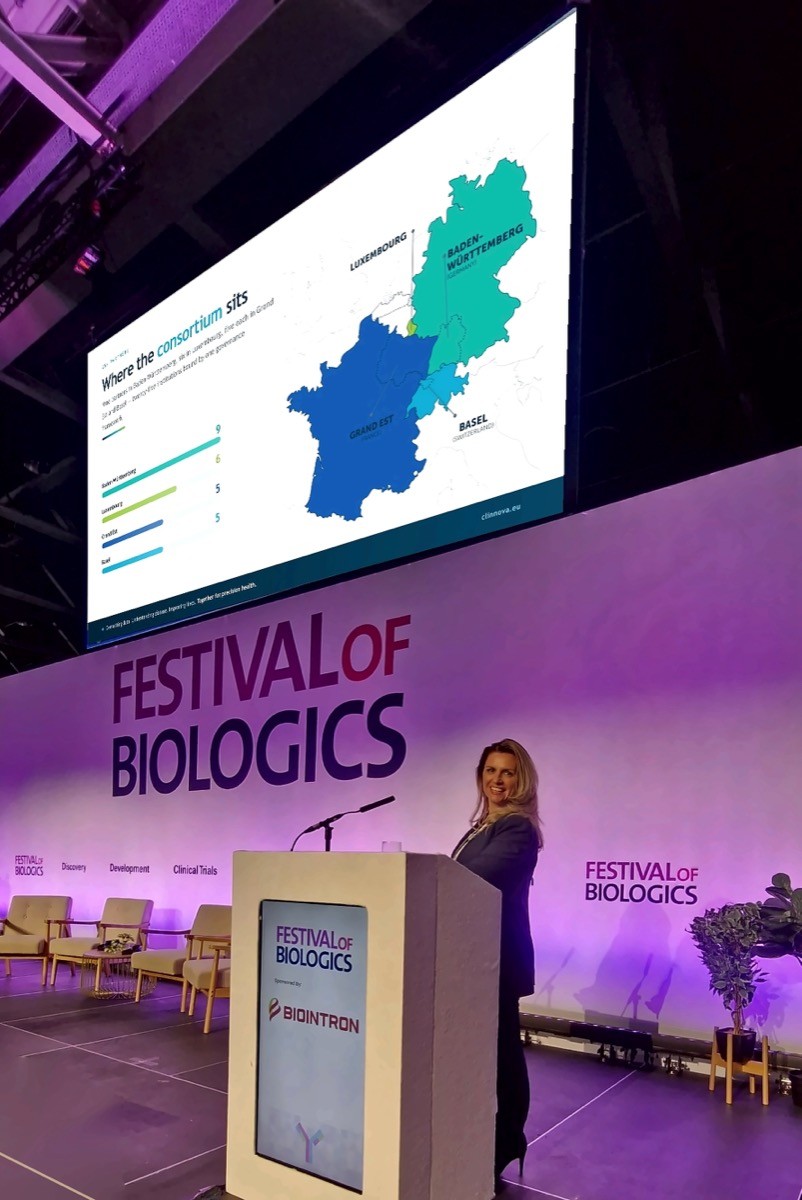
Photo: Dr. Bebeka Cosandey presenting Clinnova at the Festival of Biologics 2026, Hall 1, Messe Basel.
Basel is one of the world’s leading hubs for life science and its Biologics Festival attracts many participants from pharma, biotech, academia and clinical research interested in the discovery, development and clinical testing of biologic medicines, with a growing focus on AI and data. In this setting, Dr. Bebeka Cosandey, Lead Scientific Program Manager from Clinnova Basel (University Hospital Basel), presented Clinnova in the AI and Computational Approaches track, under the title “Building cross-border AI-ready data infrastructure and next-generation clinical trials.“
Clinnova is a cross-border initiative involving more than 25 partner institutions from Switzerland, Luxembourg, France and Germany, including hospitals, universities, research institutes and industry partners. By giving researchers access to clinical data across national borders, the programme aims to strengthen collaboration and ultimately improve patient care, while ensuring that sensitive patient data remains securely stored within each institution. This is made possible via shared clinical protocols and federated learning, an approach that allows AI models to learn from data held at different hospitals without the data itself having to be transferred. A first proof of concept in 2025 demonstrated the feasibility of this approach across hospitals in two countries. As Dr Cosandey aptly summarised: “The data never moved. The learning did.”
Since then, Clinnova is gaining momentum. Ten clinical centres now work together in one federated network, and the consortium continues to grow. Its presence at one of Europe’s largest biologics events reflects the growing interest in infrastructure that makes clinical data usable at scale.
The timing is also important as Clinnova’s work is taking shape at a time when Europe is establishing a common framework for the use of health data. The European Health Data Space (EHDS) Regulation, which entered into force in March 2025, is intended to facilitate the secure use and exchange of health data for research, innovation and healthcare. Clinnova shows what this can look like in practice with its shared standards and strong governance systems that protect patient privacy across four national healthcare systems.
The next phase will focus on establishing a shared data catalogue, extending federated analyses across the participating sites, and preparing the first clinical decision-support pilots. Engagement with industry and research partners will be key to translating the infrastructural achievements into practical applications for clinical research and, ultimately, patient care.
Related News
-
Clinnova: building a strong foundation for future clinical research in Luxembourg
-
Clinnova publishes its 2025 Annual Report
-

Advancing Precision Medicine Through Smarter Statistics: Clinnova at SIS–FENStatS 2026
-

Clinnova Recognized as a Flagship Programme for Digital Medicine
-

Clinnova Consortium Agreement Officially Signed Across All Partner Countries
-
Clinnova Rheumatic Diseases to a Co-Created Research Submission Template
