
Clinnova: building a strong foundation for future clinical research in Luxembourg
At the launch event for Luxembourg’s new national clinical research initiative, the Luxembourg Research Clinic, Dr Jasmin Schulz demonstrated how Clinnova is building a national data infrastructure that will support projects far and beyond its own purview

On 29 September 2026 at the launch of the Luxembourg Research Clinic (LRC), Dr Jasmin Schulz, national coordinator of Clinnova at the Luxembourg Institute of Health (LIH), explained how the programme is helping create the structure needed to connect healthcare and research. While Clinnova is focused on its patient cohorts in three specific disease areas, its ambitions extend much further, laying the groundwork for a more interoperable national research environment.
Clinnova goes beyond patient cohorts
Clinnova is a cross-border precision medicine programme involving public partners across the Greater Region. Funded with €50 million from regional partners and the Luxembourg National Research Fund (FNR) via the National Centre of Excellence in Research (NCER) scheme, the programme aims to establish an interoperable data environment that enables researchers to make better use of health data while respecting the sovereignty of the institutions that hold it.
The programme includes patient cohorts focusing on inflammatory bowel disease, rheumatic diseases and multiple sclerosis. These cohorts provide concrete use cases for developing and testing approaches to data integration and analysis, including the use of artificial intelligence (AI) and machine learning to support more personalised treatment decisions.
However, the cohorts are only one part of the programme. A key objective is to establish the infrastructure, standards and workflows in Luxembourg that will make it possible to integrate health data from different sources and institutions, enabling future research programmes to build on the same foundations. This is especially relevant for the new Luxembourg Research Clinic (LRC), which is a partnership made up of six national institutions and hospitals.
Building the foundations for data-driven research
As Dr Schulz explained in her presentation at the launch event, effective AI applications depend on reliable, well-structured data. This requires a high level of data quality at the source, information organised according to recognised standards, and robust processes to ensure that data can be used securely across institutional boundaries.
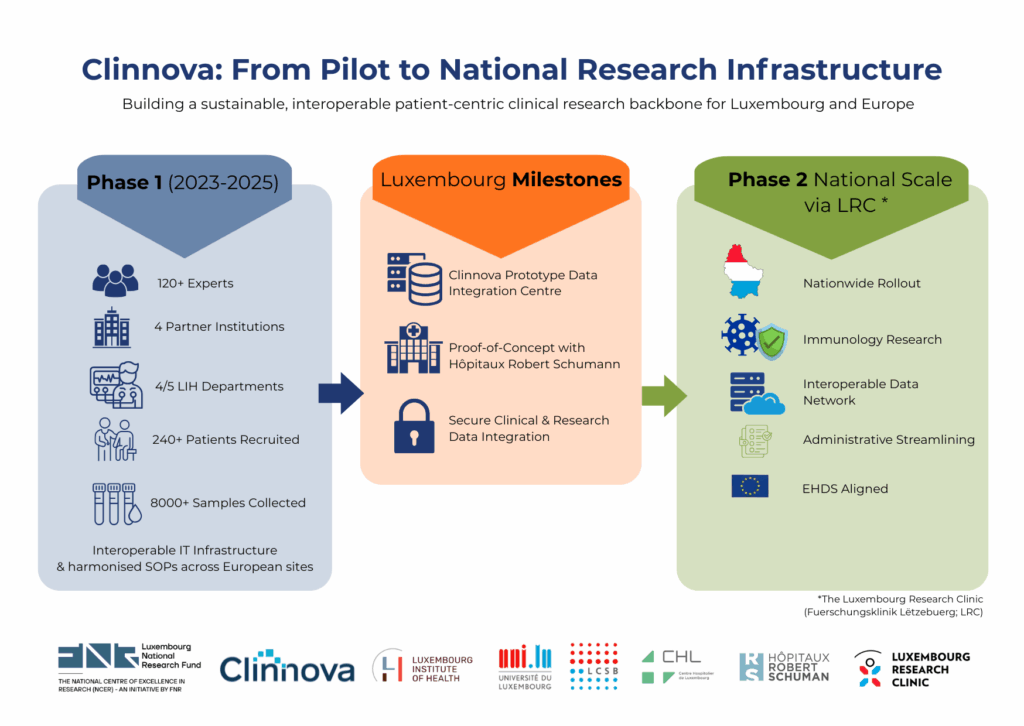
To this end, Clinnova has developed a Data Integration Centre (DIC) to support the standardised collection, preparation and integration of clinical research data. Initially designed for the programme’s specific research needs, its scope is currently broadened to support a broader range of studies over time.
The longer-term vision is to connect local data integration capabilities into a federated network. This approach allows researchers to analyse data across participating institutions without requiring all the underlying data to be transferred into a single central repository.
Clinnova is much more than a cohort study. The cohorts are very important as they give us concrete use cases, but the real value is in the infrastructure, standards and workflows that we are building to make health data more accessible for research. These foundations can support future studies and research programmes well beyond Clinnova itself,
said Dr Jasmin Schulz, national coordinator of Clinnova.
Connecting clinical research across Luxembourg
The development of this infrastructure also has important implications at the national level as Clinnova is working towards integrating its data processes with Luxembourg’s hospitals and research institutions within the LRC framework. By linking clinical research activities across national partner institutions, the LRC aims to strengthen the country’s capacity to conduct clinical studies and significantly improve patients’ access to them.
Clinnova’s work on interoperable data systems, shared standards and federated analysis offers a foundation that can be built upon by future research initiatives in Luxembourg as well as across borders. Its contribution to the LRC illustrates how investments made through a specific research programme can also strengthen the wider clinical research ecosystem.
Related News
-
Clinnova publishes its 2025 Annual Report
-

Clinnova Recognized as a Flagship Programme for Digital Medicine
-

Clinnova Consortium Agreement Officially Signed Across All Partner Countries
-

Clinnova Rheumatic Diseases to a Co-Created Research Submission Template
-

First Patient Enrolled in the Clinnova IBD Use Case at the Basel Site
-
Clinnova completes Phase 1 and becomes a cornerstone of Luxembourg’s national patient-centric research infrastructure
